
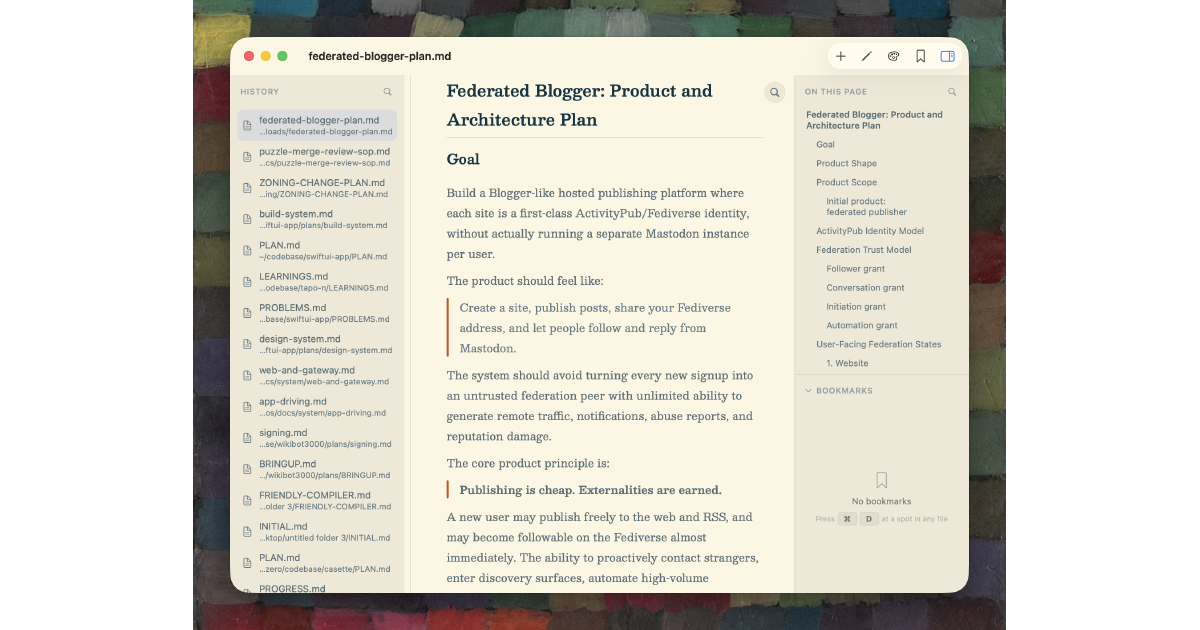
It's time to stop drawing user interfaces with punctuation characters. Native UI is a completely solved problem.
Added by
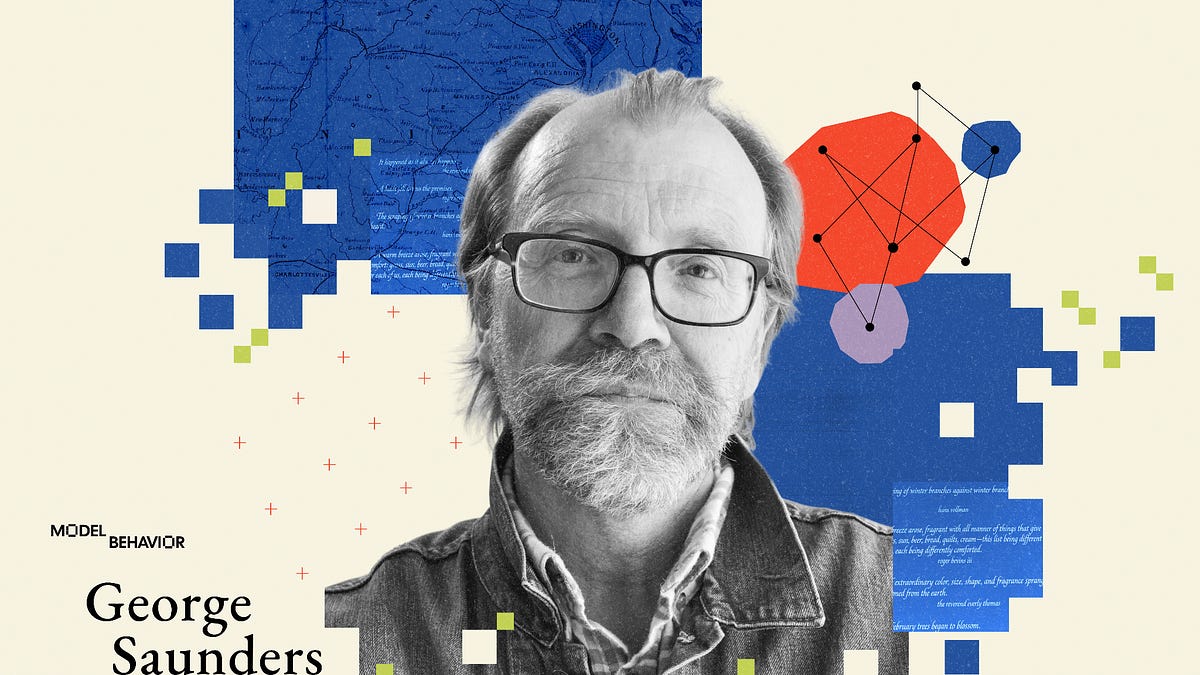
 Model Behavior: George Saunders (opens in new tab)
“Of course, if AI can cure cancer, bravo. I’m all for it. But even with cancer cured, death will still arrive somehow.”
And I think it’s harmful and dangerous to give over too easily this precious human thing called storytelling. Storytelling is something humans do, a human-to-human, highly advanced, nuanced code, a super-intelligence all our own. It doesn’t work without two humans in it. And it’s not a neutral decision, to give that up, but, like so many things these days, we seem to be doing it because . . . it can be done. (“I can make a drawing of a cat driving a snowmobile in the style of Rembrandt!” “I can make an album though I know nothing about music and can’t play an instrument!” “I can redo my resume in 10 seconds!” “I can get a first draft of my novel by giving AI a rough outline!”) But: Is it your resume? Is it your novel? Did you have a sufficient hand in it? Or did you just unwittingly sacrifice a precious chance at originality or idiosyncrasy that might have spoken, in some subtle and irreducible way, to the person reading the thing?
Also, mortality, and all the anxiety that comes with it, and that feeling of being at a beautiful party that is ending, but no one can tell us just when.
Added by
 China has cracked down on AI relationships. Is it ahead of the game? (opens in new tab)
Beijing has cracked down on AI chatbots that can replicate human relationships. Experts are asking if this is the right thing to do.

Added by
 People are reclaiming the computer (opens in new tab)
Observations from a few recent tech meetups.

Added by
We want technologies in classrooms that reward knowing things, it’s good actually
Curator note> That’s not what teachers are being shown, and of course with the current techlash moral panic1 many people are being scared away from learning it. But that’s the opportunity. To not be introducing our students to these possibilities and new ways of applying their knowledge seems to me almost c
Added by
 This [Ai]n’t the Way | Caught by the River | Caught by the River (opens in new tab)
AI-generated articles about nature are fundamentally at odds with what we’re doing here, writes a very tired site editor.
Has an AI agent ever got lost? Pulled a tick from its hip because it neglected to tuck in its socks? Gone out in the middle of the night to look at the moon? Stayed up reading by lamplight? Seen a young deer on the side of the road, glassy-eyed, and cried, or poked a different dead thing with a stick, or deliberately left the mistakes in its knitting, or thought oh god, my dog is so beautiful?
Added by
 ‘Doom Loop’: OpenAI and Microsoft Admits LLMs Are Destroying the Web and Built on Theft (opens in new tab)
"Millions of people around the world will soon consider large models ‘hoovering up’ all their work to be an astonishing theft of unprecedented proportions."
Added by
Then we’ve got a student experience that might have 3 different experiences/tools/capabilities just within Google Sheets. Middlebury offers the free edu version. No Gemini in the Sheets toolbar. I don’t know for sure if that’s a setting choice or a license choice. Students with a free Google account will have Gemini in Sheets . . . They can also get a free year of Gemini Pro (Sheets integration plus other stuff) after proving they are a Middlebury student BUTTTTT that will be in their personal account not their Middlebury account. Sheets Canvas fits in there somewhere.Old man shakes fist at internet cloud provider.
Keep in mind this is just stuff to worry about in Google.
Curator noteTom Woodward <blockquote> Establishing and agreeing to new workplace norms for this is going to be just awful.</blockquote>
Added by
 Slow AI | Dr Sam Illingworth | Substack (opens in new tab)
Knowing when to use AI and when to leave it the hell alone. Click to read Slow AI, by Dr Sam Illingworth, a Substack publication with tens of thousands of subscribers.
Added by
Most big corporate efforts to use A.I. to increase productivity fail — perhaps as many as 95 percent, according to an M.I.T. study published last year. A boss sits a team down — let’s say it’s a financial services firm, or a consulting firm — and asks them to use A.I. to improve the sales process or track relationships, and after a lot of trial and error, it doesn’t work out. This finding is quite awkward, given the projected multibillion-dollar valuations of A.I. companies, but nothing I’ve learned from talking to dozens of people in the industry disproves it. People are hopeful that a bold A.I.-powered future is right around the corner. They are tantalized. They often use A.I. tools all the time individually. But companies’ internal efforts don’t work.
Curator noteFrom Paul Ford
Added by